Showing posts with label TU. Show all posts

Tuesday, May 5, 2009

Tony noms are announced!

I must digress from crossing cultures right now to address the recent Tony Award nominations.

The first and most important element of this entry is to extend a congratulations to Towson University's own John Glover, alum and visiting acting instructor, on his nomination for Best Featured Actor in a Play for Waiting for Godot. Those who aren't familiar with Glover may know him from television as Lex Luthor's father, Lionel, on Smallville, or most recently, as Sylar's father on the supernatural drama Heroes.

I've had the privilege of working with Glover in my Acting I and Directing I classes, and he frequently returns to Towson when he's not busy starring on Broadway or in top-rated TV shows. He prides himself on offering real-world advice to students.

As for the rest of the noms, the Dolly Parton musical 9 to 5 is up there, as well as Shrek: The Musical and Next to Normal, which opened at Arena Stage in DC before finding fame on the Great White Way. Hollywood actresses Jane Fonda, Marcia Gay Harden and Angela Lansbury are also in the running for an award.

Godot is also up for Best Revival of a Play and Best Costume Design.

For a full list of the nominations, check out the Tony Awards official site. Tune in to the Tonys on Sunday, June 7th at 8/7c on CBS.

--DQ

Thursday, April 30, 2009

The powers of theatre, Part I

Theatre of Crossing Cultures is one of my two theatre classes this semester. It's a bit different than your typical classroom structure. No exams, no lectures, no note-taking. Instead, we play a ball game every day, sit in a circle, and laugh and cry over each other's innermost secrets.

Sounds more like a camp pow-wow than a 300-level college course, right? Well, Barry, our teacher, is respected within the Theatre Department, even if he is a little unconventional. He drives his motorcycle to work and pushes around a shopping cart from Linens 'N Things full of shiny objects, noisemakers, bells, whistles, and decorations. He reminds us of his credo every day: "I have nothing to give you," rejecting the structure of the American education system and instead encouraging us to learn from each other.

I have to say that I've never had a class quite like it before. Although theatre classes are generally a bit more movement- or action-oriented than typical lecture or lab classes, I've never initiated class every day with tossing a globe-sized ball at my classmates to learn their names, or had the chance to share some of my most life-altering moments with people I hardly know.

There's a lot I want to say about this class; I'm breaking it up into a series of posts so it doesn't get monotonous. But if you want to get into the crossing-cultures mindset, ponder the following and all of its possible meanings:
"Who are all those people you have brought with you?"
The disciple whirled around to look.
Nobody there. Panic!
Lao Tzu said: "Do you not understand?"
Welcome to Theatre of Crossing Cultures. It's a wild ride.

--DQ

Monday, April 27, 2009

Lighting jitters, again

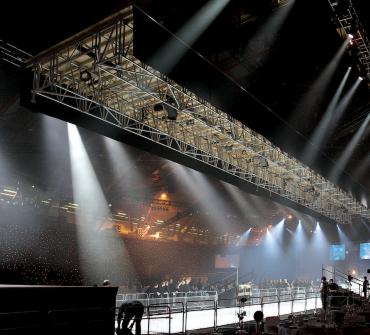
I once again caught myself in that difficult situation of being uncomfortable doing lighting work because of the height factor involved. Only this time, it was in the catwalks of the Mainstage
Theatre, and there was no steel grid to save me.

Focus for TU's production of The Time of Your Life, which opens this weekend, took place last week, and I thought it wouldn't be a big deal because I got through the last lighting-way-above-the-stage adventure with flying colors. But this time, all of us were assigned to specific lights to focus as the lighting designer called up commands from the stage, and we were expected to know how to adjust a light properly.

Not to mention we were dealing with heavy, complicated units that cost thousands of dollars apiece and could kill an actor should one of them fall.

It was nervewracking. Leaning half of my body out over a flimsy metal rail to insert color into the end of a light is not my idea of a tea party. It was dark, dusty and hot, and further reaffirmed by suspicions that I am not meant to be a lighting designer, or even part of a lighting crew.

I'll keep my theatre career grounded, thank you very much, either on stage or behind it, and let the people who can't get enough of climbing around the rafters like monkeys do their jobs.

--DQ

Wednesday, April 8, 2009

Five questions for an aspiring playwright

Last month, I mentioned my friend Janet Jiacinto, who was in my Playwriting class and who will soon be staging her self-written play, Chapstick Smells Like Fish. She recently gave me some insight into the process of writing a play and having the opportunity to perform it.

How did your concept for the play evolve in your head, before, during and after Playwriting class?

I was taking an EMF class where we were required to keep a dream journal. That was when I first started thinking about the concept of unspoken dream logic. This is the way, in dreams, you can be in what looks just like your living room, but it's not actually your living room -- it's a swimming pool or something.

Dream sequences happen all the time in movies, but I'm not sure I've ever seen or read something where the entire thing is a dream. I thought it would be cool to try to find a way to stay true to the world of dreams without becoming so convoluted that no one understood the story.

When analyzing a play, one of the first questions you should ask is "Why is this day different from all other days?" because if it isn't, not much is at stake. It's the same with writing. So, I stole some characters I liked from another play I've written and picked a day in one of their lives that they could never forget.

The feedback in Playwriting class and Playwriting Laboratory was absolutely vital to Chapstick's development in that it helped me to shape the characters and shifts in logic so that they made as much sense as possible without perverting the nature of the world.

When did you know that you wanted to potentially produce it?

I sincerely doubt the existence of professional playwrights who work on plays with the idea that they'll never see a stage. I can't write a play without visualizing it in a certain space. I've been working on Chapstick for roughly a year, it's gone through three workshop readings, and I reached the point where I had a script and wasn't sure how else to make it better.

Since the setting is so minimalistic, it is an extremely easy play to produce. The challenge is in making the world something easy for the audience to understand. The production will be more like a workshop in that I want to stage it to find problems in the script that wouldn't be obvious for a reading.

Do you think that since it's a bit abstract to most people, students will respond positively to it?

I certainly hope so. The story walks this fine line between ludicrousness and realism and in doing so finds this place where we can believably say and do things we never would in reality.

Has any particular play, playwright or other person or thing inspired your work?

Every character in the play is based, however loosely, on someone I've really known -- even Ashu, the character who ranges from Sean Connery to a cartoon.

What do you hope to do by producing your play at TU?

By putting a play into the hands of actors and designers, new things will be found in the script. A lot of things the playwright didn't intend to put in the play suddenly become unspeakably important. Stage directions are a whole different world when they're no longer words on a page. Unless the story is completely antiquated, a play is not meant to be read but seen. That's why I believe every play should be forced through at least one workshop performance before it's declared to be a final draft.

Janet's play will be performed as part of Towson University's 2009 Fall Season. (Photo courtesy of Janet's facebook page.)

--DQ

Monday, April 6, 2009

Senior theatre thesis: been there, done that

Facebook, one of my many online social networks, is my number one friend-stalking tool. I constantly refresh my page when I don't have anything better to do to see who updated their statuses, simply because I want to know about the cool things going on in their lives, or lack thereof lately, as most of us find ourselves up to our ears in mid-semester schoolwork, projects and papers.

Sifting through statuses the other day, I had to laugh at what I saw.

Several theatre majors I know had things posted like "is in the library from now until the end of time" or "has 10 pages down, 10 more to go" or "needs some distraction from Stephen Sondheim for a while." Ohhh, yes, I thought, smiling to myself superiorly. It's THAT time of their college careers as theatre majors.

The dreaded senior theatre thesis. I can hear the dated horror movie screams now.

I'm not sure why Towson requires its theatre majors to write a 20-page thesis before they can earn their degree. I speculate about it all the time, wondering if the university administration thinks that as mischief-making, obnoxious theatre kids (come to a cast party and you'll see what I mean), we don't take ourselves seriously, or whether they believe because we have a number of courses that stray from the typical lecture-exam class structure that we're not retaining information as well as other students in other majors do.

Regardless, it's unavoidable. I mocked my research-laden friends, especially the ones who are preparing to graduate in 46 days like me (oh yes, the countdown began a while ago), and gave myself a pat on the back for deciding to write my thesis the semester before my last semester.

I thought I didn't have motivation then? Ha! I certainly don't have any motivation now, definitely not enough to even begin to think about writing a worthwhile thesis.

Well done, Dana. You made a good decision last semester, even though there were nights you felt like tearing your hair out as you labored over the computer screen writing about French translation in theatre.

Best of luck to my comrades, but I don't envy you.

--DQ

Friday, April 3, 2009

Audiences will swarm to "Bug"

I must admit something.

I committed the numero uno theatre etiquette no-no tonight upon my arrival at Towson University's Center for the Arts to see the much-anticipated Bug: I was late for the show. Only by a few minutes, due to a slow dinner waitress (*grumble*), but late nonetheless.

As I entered the theater, I heard a phone ringing from the stage, a clear indicator that, much against theatrical tradition, the show had started on time. I cursed under my breath and followed the usher up the stairs behind the seats in total darkness, trying not to miss one and consequently break my face. At the top, I was directed to an open seat. In the third row.

As I descended the center aisle of stairs, I could feel eyes from both sides watching me, scorning me for being an unnecessary distraction to the hardworking actors on the stage at floor level. As I spotted my seat, I cringed as I passed in front of everyone in the row, who were ironically enough some of my fellow theatre majors (and etiquette-followers). It's safe to say I was nothing short of mortified.

However, the actors didn't much seem to mind as they carried on with the production, which, I might add, was spectacular. Aside from a minor set malfunction, the acting was emotional and impressive, and the characters, raw and real. It's a high-energy dark comedy, much unlike the yawn-inducing Miss Julie, and its obsessive, neurotic themes (namely, a bug infestation which is possibly a schizophrenic delusion) create a multitude of tension and action-packed character interaction. Blood is spilled, hearts are broken, and there is even a hilarious scene where two of the characters waltz to Patsy Cline's "Crazy" in gas masks and lab coats.

Bug is highly enjoyable and different from much of the Mainstage work Towson produces, as Peters promised it would be. You could even say it was...infectious.

--DQ

Thursday, April 2, 2009

Backstage at "Bug" - Part 2

It's opening night for Bug, which runs until Saturday in Towson University's Ruth Marder Theatre. Tickets are $2 for students and $5 for general admission.

Here are a few more behind-the-scenes tidbits from the production work this week.

First: deciding on colors for a door. It's a process, I kid you not.


Last: the set finally begins to take shape.


If the desire strikes you, enjoy the show; I'll be there Friday and will see you right back here afterward.

I remain your DQ.

Monday, March 30, 2009

Backstage at "Bug" - Part I

Tech week is in full effect for Towson's production of Bug. I spent some time there on Sunday doing production work and captured some of it to share with you here.

First: welcome to the Ruth Marder Theatre as you've probably never seen it.


Second: meet the director!


Third: experiments with blood capsules.


This is just a preliminary glimpse into what goes into putting together a production. Part 2 of behind-the-scenes footage to come!

--DQ

Thursday, March 26, 2009

Chatting with John Freedman

John Freedman, an American-born translator who lives and works in Russia, spoke to my Russian Theatre and Politics class today about his experiences both in Russia and with translating some of the plays we're studying.

With regards to choosing the title for the play Frozen in Time, a modern day Russian Romeo and Juliet, Freedman noted that the original Russian title, Exhibits, didn't exactly do the piece justice.

"It's interesting, the power of choices," he said. "'Exhibits' doesn't really give you a feeling. It doesn't give you anything. A title should point you in a certain direction, make a suggestion. I thought 'Frozen in Time' sounded much more influential. It implies not moving on, losing something that is part of human experience."

After seeing one of the first performances of Frozen in Time in Moscow, Freedman left disappointed and confused.

"For me, it lost a lot of course," he said. "You didn't get the way little things kind of build up and lead to the explosion. It's a difficult play to do. If I were directing it, I'd come back to this: you cannot create characters of these people. The ambiguity is very strong. You're encouraged to take sides and make judgments. If you have done that, you've started losing touch with the play. Everybody's life has its right to be expressed fully. The difficulties and conflicts we experience are legitimate. I love that ambiguity; it makes me accept everyone and everything."

Freedman also clued the class in about certain aspects of Russian culture. Infidelity, he said, while frowned upon, is not such a moral problem as it is in the United States. Gender roles that used to exist in the United States are still prevalent there, where in the most general terms, the females typically are the nurturers and the males are the protectors.

"There's a certain understanding of life that Russians have," Freedman said. "There's a sense that life itself is sacred, not the morals attached to it."

Freedman's endeavors in the emerging Russian theatre world will be transformed from page to stage this fall in the premier of the TU Theatre Department's "Russian Season," featuring several of the plays he's translated over the span of his impressive career.

For more on Freedman's experiences and life in Russia, journalism and theatre, head here.

I remain your Drama Queen.

Saturday, March 14, 2009

She made a scandal and a start

Last semester, I took a class called Playwriting. It's not too hard to discern what the class was about. It was an absolute blast because I love love love to write, and our teacher, David White, is one of the most interesting, knowledgeable people I've ever met in my entire life. But, I digress.

The coursework consisted of us writing a 10-minute play and a one-act play, which we would then cast and read within the class and revise and read again. We also had the opportunity to submit them to young playwriting festivals in the area.

My friend, classmate and fellow theatre major, Janet, wrote an abstract play that is now being produced in the department during next fall's jam-packed season. She will direct it herself.

I've requested an interview with Janet, and hopefully can get in contact with her within the next few days and share her ideas with you. Stay tuned.

--DQ

Friday, March 13, 2009

We sat there sighing, groaning and crying

DISCLAIMER: As a member of the TU Theatre Department, I have only the utmost respect for my peers, the faculty and all of the productions that take place within the department itself.

But I must be honest here. I expected much more of Miss Julie.

While it is a play comprised of compassionate dialogue and deep, emotional characters, it was all a bit much for me. The play functions in one hour-and-45-minute scene without an intermission, over half of which follows the title character's yearns for affection from her lover and servant, Jean. All Miss Julie does throughout the entire play is beg him to love her, and I've never seen a more desperate, pathetic character in all my life. She winds up killing herself at the end of the play, and I wish I could have been the one to drag Jean's razor across her throat instead of her dying by her own hand, just so I wouldn't have to hear her whine anymore.

Easily, the most interesting part of the show was a ten-minute interval where, after Jean, Miss Julie and the other servant, Kristine, have gone to bed, the estate's farmers romp about the room, destroying things, throwing flowers everywhere, making love, shouting, laughing, and stomping around in a drunken display of joy and carefree life.

I don't think it was anyone's fault that the production didn't turn out the way I expected; the acting itself was decent and everything worked well as far as the production as a whole is concerned. I just think the play itself was not all that intriguing.

Here's to Time of Your Life being more enjoyable when it opens in May.

--DQ

Tuesday, March 10, 2009

There's a moment when fear and dream must collide

It was a cruel realization when I signed up for the required theatre course, Lighting Crew, this semester: I'd have to face the one thing that theatre majors of all people should get over REAL fast.

My fear of heights.

In a field which incorporates hanging lights, pulling curtains, dropping in microphones, acrobatics, and the like, a fear of heights can seriously hold a theatre person like myself back from experiencing the finer elements of the technical work that goes on behind the scenes.

It was never a big deal for me riding roller coasters in theme parks or even climbing the 990-foot-tall Eiffel Tower. But get me on a lighting catwalk and my legs turn to jelly as I gaze down into the expanse of the theatre house below me, which wouldn't be such a comfy landing.

Alas, the day came when my fears came around to face me. On the first day of Lighting Crew, we were set to hang lights for August Strindberg's Miss Julie. I entered the Studio Theatre in Towson University's Center for the Arts with my head held high, even though deep down I was ashamed that someone involved in an art where anything is possible could possess such a fear.

As it turned out, I wasn't the only one. Some of the other crew members requested other tasks that didn't involve being so far above the stage. I opted to face my fear and do what I came there to do: hang lights. The cool thing about the Studio Theatre is that the entire lighting area functions on a giant steel grid directly over the performance area, so if the lights (or a person) should fall, they would be caught by the steel grid. The springy grid was actually quite fun to walk on, and after a while, I started having conversations with some fellow theatre majors on the stage below who were painting the set, and I forgot all about my apprehensions from earlier that day.

My light circuiting handiwork, which took several hours but was fun all the same, can be seen in Miss Julie, which runs until Thursday at TU. Tomorrow I'm seeing the show; see you after right here.

I remain your fear-conquering Drama Queen.

Friday, March 6, 2009

The cast is great, the script is swell, but this we're telling you, sirs...

A couple of entries ago, I mentioned that each theatrical season at TU involves not only the larger Mainstage productions, but also student-directed shows, where theatre majors have the chance to cast and direct a show of their choice rather than perform in it.

I spoke with graduating senior Andrew Peters, an Acting student who is directing a play called Bug this spring, set to open next month. As a young theatre artist, he gave me some insight into the directing experience.

What drew you to Bug and why did you have an interest in directing it?

I first read Bug a few years ago and I've always been drawn to how visceral and gritty it is. It's a love story, a thriller, a piece of science fiction, a dark comedy...all of these different genres all wrapped into one. As a student director, I wanted to direct something challenging and gritty, but something that would allow me to also flex a creative muscle so to speak. It also came down to what I thought would not only interest theatre artists, but the Towson student body as well. With most of its Mainstage repertoire, the Towson theatre department puts on shows that I feel are good learning experiences, but I don't always feel that they are chosen due to what students our age actually want to see. So I wanted to do something very raw, provocative, and fun, but still doable in a college environment.

Author Tracy Letts is also responsible for the Tony Award-winning play August: Osage County. Did this success have any effect on your decision to direct Bug?

The fact that Letts is becoming a huge name in the theatre world definitely influenced my decision. In general, I wanted to do this to get his name out there to a younger audience because I think he's going to be someone who continues doing work for years, and if I can spread his work around to as many people as possible, I'd do it in a heartbeat.

As a theatre student, how valuable is it to have this kind of behind-the-scenes, hands-on experience with a show?

You learn a lot about the process that certain things like classes and such won't teach you. I've been in a good amount of shows here at Towson, but directing a show has taught me so much more than I could've gotten from actually being on stage. You learn about the process and the ways to adapt to it.

What have been your favorite moments so far?

Sometimes, we've stumbled into territory I never expected. For instance, I love it when the actors take a risk with a way they deliver a line or an action they perform, and it completely makes me rethink my original ideas. Also, seeing the show on its feet as it progresses is incredibly exciting each step of the way. The first time we put together Act 1 in one night, I really got a sense that we were well on our way.

Do you have any advice for future student directors?

One, don't be afraid to take risks. Jump in head first! Second, think around the box. With Bug, there are a lot of technical things that I am working around now that I've been able to brainstorm solutions for, and I'm really excited to see how those choices will pay off when the performances start. It's a thrill to be able to see how you can play with a concept and adapt a piece of text to it.

Bug runs April 2 - 4, 2009, in the Ruth Marder Theatre at Towson University.

--DQ

Wednesday, February 25, 2009

There may be something there that wasn't there before

The Fall 2009 Season for the TU Theatre Department has just been announced. Every semester, we typically put on two large Mainstage shows, and then undergraduate students in the department direct their own shows and graduate students stage their works, usually self-written. So ideally there are four or five shows running per semester.

The fall season is introducing a foreign influence. I know I'm getting a bit ahead of myself here, but my last entry mentioned England's excellence in the art and the Russian project I'm involved in. Well, fancy that. William Shakespeare's classic love story, Romeo and Juliet, will be staged here in the fall. Usually the department does put on historical plays of some sort, like last fall's The Crucible (set in Puritan Salem) and The Piano Lesson (set in 1930s Pittsburgh). Performing Shakespeare is something Towson hasn't embraced in several years and it will take this department one step further into our historical endeavors as we bring Elizabethan Italy to the stage.

The second Mainstage show will be the Russian play Tanya, Tanya, translated by American translator John Freedman (seen on the left) and directed by Russian guest director Yury Urnov, both of whom have been actively involved in TU theatre for some time now. The show is still being adapted for performance, but the department is excited to debut this work on Towson's stage.

Another new Russian play called The Polar Truth will be staged in the structure of a performance workshop by one of the department's graduate students.

These relations with Russian theatre artists has had remarkable impact in the past few weeks and it's already spread like wildfire into the department, and hopefully it will continue to delve further into crossing cultural boundaries in the future.

--DQ

Monday, February 23, 2009

But I know the answers lie far from this world

When American theatre goes international, things can get quite exciting. It's no secret that other countries like England, home of the Bard himself, are truly cultured in the art. Thus, I am quite excited to share this news with you.

The theatre department here at Towson University has been involved with Russian directors and translators for a few years now, and these relations have been steadily improving. With that came the idea for a new interdisciplinary project in the structure of a class. It's called Russian Theatre and Politics, and I am currently enrolled.

Russia has had considerable political turmoil until only recently, and so they are entering a new era of freedom in the theatre. With that in mind, the premise of the class is that students from both the theatre department and the political science department (as well as a few international studies majors) have the chance to take this class together, each to learn about the discipline they know least about. It's taught by two instructors, Dr. Robyn Quick from the theatre department and Dr. Alison McCartney from the political science department. The coursework involves reading Russian plays and examining them in their contexts as part of Russian political culture. It's both a history lesson and a look into an art that is emerging as an important cultural aspect in the largest country in the world.

This also means that, as students in this experiment, we are going to be the first Americans to read new and still-in-the-works translations of some of these plays. How exciting it is that we are part of Russian theatrical history!

Because of the groundbreaking work we're doing in the class, we have been invited to attend a Russian Ambassador's speech next week at the World Trade Center in downtown Baltimore. I'll be sure to report back here after it's over. I hope to make this experiment part of a series of posts here.

Fine arts have such power to open doors and to cross cultures, and that's true now more than ever before.

I remain your Drama Queen.

Monday, February 16, 2009

It's a struggle, it's a war, and there's nothing that anyone's giving.

Going to the theatre has often been viewed as a high-society aspect of the American culture, much like going to an opera or orchestra concert. As more and more young people have become involved in the industry and with the influx of new companies being formed across the nation, the notion that theatre is only for uppity folks has diminished.

Unfortunately, the upper-class values of attending a show have gone with it. While theatre now is flourishing with new works and greater diversity than it's ever had, theatre-goers are not so keen on what is and isn't appropriate when one is a member of an audience.

I ushered Towson University's productions of Arthur Miller's The Crucible and August Wilson's The Piano Lesson last fall, and part of the requirements of an usher are to help seat audience members and to sit in during the performance to make sure nothing in the audience will distract the actors.

What I saw was appalling.

Despite the announcements before the performance began urging everyone to please silence all cell phones and refrain from sending text messages during the show, I saw numerous faces lit up by tiny screens and had to repeatedly ask the perpetrators to put their phones away. By the end of the shows' runs (having seen each four or five times, and consequently witnessed much audience misbehavior) I was frustrated and insulted as someone who takes this art very seriously.

So, for anyone who doesn't often attend the theatre, here is a simple guide to theatre etiquette.

1. Turn off your cell phone, and don't check it or text message during the show when the lights are off. Even though you may be covering the screen with your hand and you think no one can see it, the house (where the audience sits) is very dark during a performance and the actors are under bright lights, so they can see the light reflecting off your face. Texting also becomes loud when the theatre is silent. The actors rely on what other actors are saying during the performance, and the sound of the keys is very distracting and can cause them not to hear a line correctly.

2. Do not bring an infant to the theatre. If you absolutely must bring your child, make sure you sit near the door. One night we had an incident where a woman's baby would not stop crying, and she didn't seem very concerned about the audience (or the actors) around her. Shows often run around two hours long, and that's quite a lot of time for a child to sit still. If you can't find a babysitter, sit near an exit so that if your child becomes fussy, you can leave quietly without distracting the actors or the audience, all of whom are trying to pay attention to the show.

3. Do not consume alcoholic beverages or illegal substances before the show. In another instance, three guys walked past me as I tore their tickets and they absolutely REEKED of alcohol. The show will be over by 10, and that's definitely not too late to start having your fun. Show respect for everyone involved in the production by attending sober.

4. Do not open candy with loud wrappers during the performance. This one speaks for itself.

5. Be attentive. You may be at the show because your Acting 101 teacher required you to see it for your class and write a reaction paper. Hooray. Watching a boring play from the 1930s is the LAST thing you feel like doing tonight. Here's a hint: you can sacrifice two hours of your life to sit through a performance, and you owe it to the people on stage who do this as their job or simply for the love of the art.

I could go on and on about what NOT to do in the theatre, but please keep these in mind the next time you attend a show, whether it's at Towson or downtown or anywhere else.

A little theatre etiquette goes a long way.

--DQ